7. Graph Cut-Based Segmentation
On this page
4.2.3: Graph Cut-Based Segmentation
GrabCut
- Good region is similar to foreground color model and dissimilar from background color
Algorithm
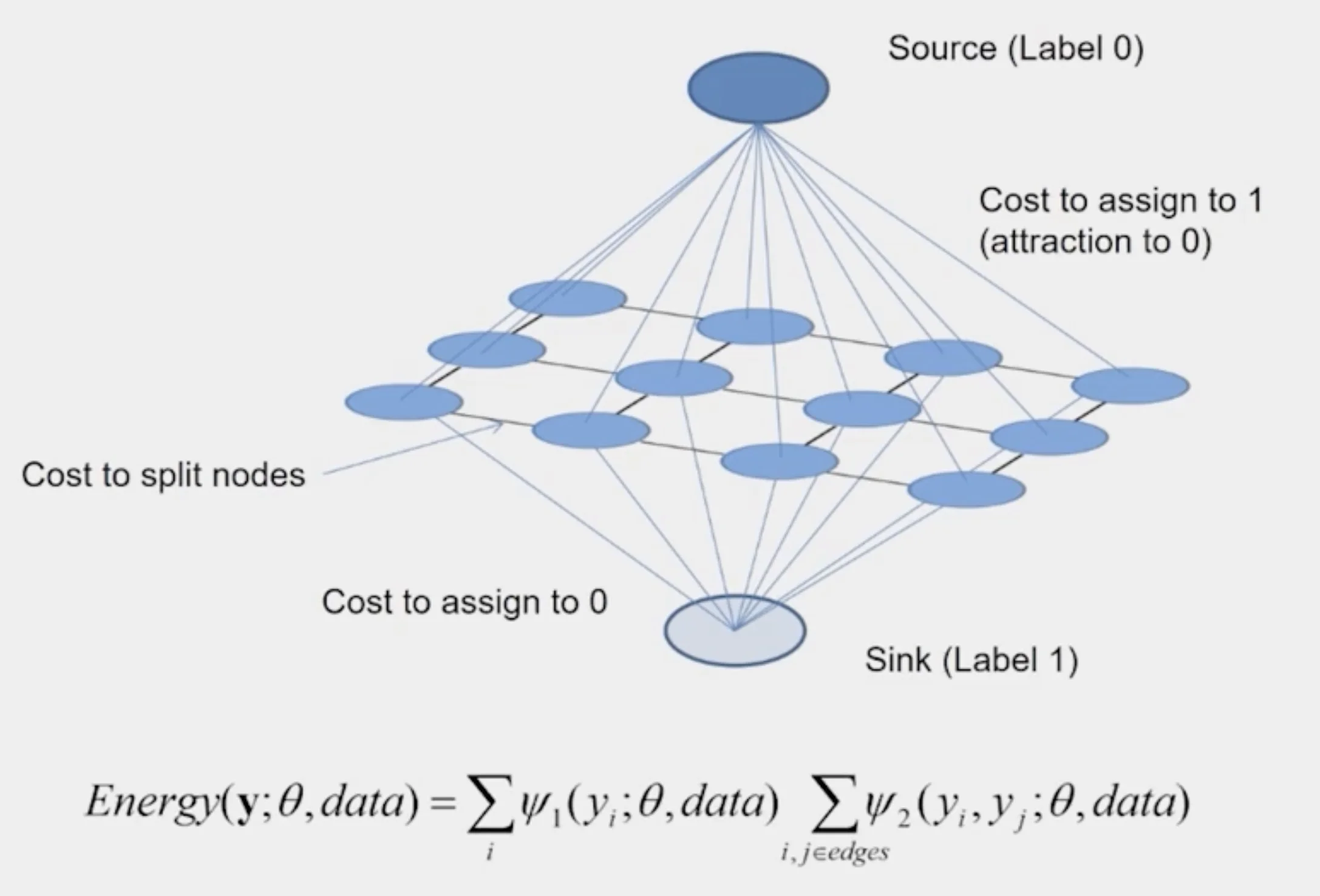
1. Define the graph
- each pixel in the image is a node in the graph.
- Local pixel relationship
- nodes are connected to their neighbors
- usually 4-connected or 8-connected
- Two additional nodes
- source (foreground)
- sink (background)
2. Set weights to foreground/background (unary potentials)
- Assign weights to pixels to measure how likely it belongs to foreground or background
- can be modeled color histograms or mixtures of Gaussians for both regions
- The unary potential is defined as:
unary_potentials(x)=−logP(c(x);θbackground)P(c(x);θforeground)
3. Set weights for edges between pixels (pairwise potentials)
- Edges connect neighboring pixels. The weight reflects how similar two neighboring pixels are:
edge_potential(x,y)=k1+k2exp(−2σ2∣∣c(x)−c(y)∣∣2)
4. Apply the min-cut/max-flow algorithm
- Find the minimum ct that separates the graph into source and sink with minimal total cost
5. Iteratve till convergence
Limitations of Graph Cuts
- Requires associative graphs
- Connected nodes should be assigned to the same label
- Only optimal for binary problems
Summary of Ideas
- Pixels are nodes
- Between-pixel edge weights based on gradients
- Sometimes per-pixel weights for affinity to foreground/background
- Good boundaries are a short path through the graph
- Good regions are produced by a low-cost cut
Take-home questions
1. What would be the result in “Intelligent Scissors” if all of the edge costs were set to 1
- The shortest path would be the shortest manhattan distance
2. How could you change boundary costs for graph cuts to work better for objects with many thin parts?
- Think about how to modify that cost to set K1 and K2 if there are a lot of thin structures
- Set the component penalizing the change of the labels to 0
- This way, for the high contrast, you will not be paying the high cost
- Apply a general cost to all the boundary so the boundary cost would not grow