Pipeline
What is pipeline?
Single cyclemechanism only allows instructions to be processed one at a timePipelineuses more throughput to allow instructions to be processedin parallel.
Caution
Pipeline DOES NOT decrease latency, and may increases it.
Instruction Stage
IF: Instruction FetchingID: Instruction DecodingEX: ExecutionMEM: Memory AccessingWR: Write back to register
Note
Each stage takes 1 cycle
Single Cycle vs Pipeline
Single Cycle
- Instructions will only be fetched when the previous instruction is done.
gantt
 title Single Cycle Instruction Execution
 dateFormat YYYY-MM-DD
 axisFormat %W

 section Instruction 1
 IF:active, des1, 2024-01-01, 2d
 ID: des2, 2024-01-03, 2d
 EX: des3, 2024-01-05, 2d
 MEM: des4, 2024-01-07, 2d
 WB: des5, 2024-01-09, 2d

 section Instruction 2
 IF:active, des6, 2024-01-11, 2d
 ID: des7, 2024-01-13, 2d
 EX: des8, 2024-01-15, 2d
 MEM: des9, 2024-01-17, 2d
 WB: des10, 2024-01-19, 2d
Pipeline
- Instructions will be fetched once the previous one has moved on to the
IDphase
gantt
 title Pipeline Instruction Execution
 dateFormat YYYY-MM-DD
 axisFormat %W

 section Instruction 1
 IF:active, des1, 2024-01-01, 1w
 ID: des2, 2024-01-08, 1w
 EX: des3, 2024-01-15, 1w
 MEM: des4, 2024-01-22, 1w
 WB: des5, 2024-01-29, 1w

 section Instruction 2
 IF:active, des6, 2024-01-08, 1w
 ID: des7, 2024-01-15, 1w
 EX: des8, 2024-01-22, 1w
 MEM: des9, 2024-01-29, 1w
 WB: des10, 2024-02-05, 1w

 section Instruction 3
 IF:active, des11, 2024-01-15, 1w
 ID: des12, 2024-01-22, 1w
 EX: des13, 2024-01-29, 1w
 MEM: des14, 2024-02-05, 1w
 WB: des15, 2024-02-12, 1w

 section Instruction 4
 IF:active, des16, 2024-01-22, 1w
 ID: des17, 2024-01-29, 1w
 EX: des18, 2024-02-05, 1w
 MEM: des19, 2024-02-12, 1w
 WB: des20, 2024-02-19, 1w

 section Instruction 5
 IF:active, des21, 2024-01-29, 1w
 ID: des22, 2024-02-05, 1w
 EX: des23, 2024-02-12, 1w
 MEM: des24, 2024-02-19, 1w
 WB: des25, 2024-02-26, 1w
Pipeline Speedup
- If all stages are
balanced
- If not balanced
What makes MIPS / RISC-V suitable for pipeline
- All instructions are
32-bits - Few instructions and regular formats
- Calculate
addressat3rdstage and accessmemoryat4thstage - Memory alignment
- memory access only takes
1cycle
Hazard
The situations where the next instruction cycle is prevented
- Structure Hazard
- Data Hazard
- Control Hazard
Structure Hazard
- A required source is
busy - Take place in systems with
single memory - e.g.
load/storeinstructions need memory access IFandIDneeds to wait until the previous instruction is done with memory access
Important
This is the reason why separating instruction memory and main memory is required.
Data Hazard
- The next instruction needs to wait for the previous one completing its data read/write
stallhappens here.
Data hazard for arithmetic instructions
- use
forwardingto resolve this hazard - Use the result once it is calculated
With stalling
- wait until
WB
add $s0, $t0, $t1 # IF ID EX MEM WB
 # /// BUBBLE ///
 # /// BUBBLE ///
sub $s1, $s0, $t2 # IF ID EX MEM WB
With forwarding
- no stalling
add $s0, $t0, $t1 # IF - ID - EX -|- MEM - WB
sub $s1, $s0, $t2 # IF - ID _|_ EX - MEM - WB
Warning
Stalling happens since the second sub instruction needs to wait until the add instruction WB to EX the operation.
Data hazard for load/store instruction
- use
stalling+forwardingto resolve
With stalling
- wait until
WB
ld $s0, 0($t1) # IF ID EX MEM WB
 # /// BUBBLE ///
 # /// BUBBLE ///
sub $s1, $s0, $t2 # IF ID EX MEM WB
With forwarding
Caution
Forwarding does not work since the value has not been fetched from memory
add $s0, $t0, $t1 # IF - ID - EX - MEM -|- WB
sub $s1, $s0, $t2 # IF - ID _|_ EX - MEM - WB
With forwarding and stalling
add $s0, $t0, $t1 # IF - ID - EX - MEM -|- WB
 # /// BUBBLE /// |
sub $s1, $s0, $t2 # IF - ID _|_ EX - MEM - WB
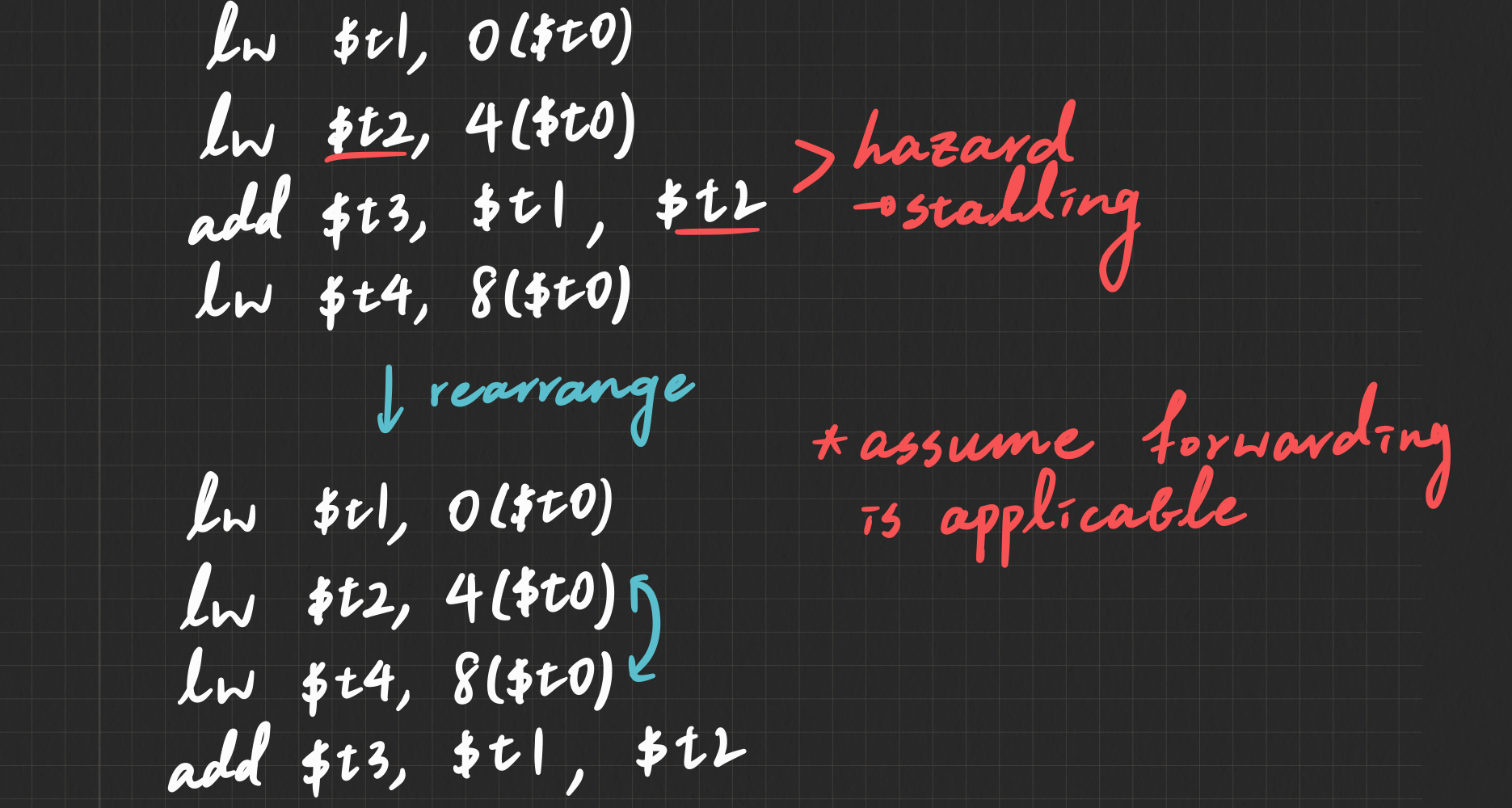
Prevent stalling by rearranging code
Control Hazard
IFdepends onbranchresult- This way,
IFknows which instruction to fetch - Require extra hardware to calculate the result in
IDstage
Solutions
stallon branch- Branch prediction
- since longer pipeline induces unacceptable
stall penalty - predict outcome of branch and only
stallwhen the prediction iswrong
Forwarding Conditions
EX Hazards
- Forward A =
10
EX/MEM.RegWrite
&& EX/MEM.RegisterRd!= 0
&& EX/MEM.RegisterRd == ID/EX.RegisterRs- Forward B =
10
EX/MEM.RegWrite
&& EX/MEM.RegisterRd!= 0
&& EX/MEM.RegisterRD == ID/EX.RegisterRt
Mem Hazards
- Forward A =
01
MEM/WB.RegWrite
&& MEM/WB.RegisterRd!= 0
&& MEM/WB.RegisterRd == ID/EX.RegisterRs
&&!(EX Hazard Forward A)- Forward B =
01
MEM/WB.RegWrite
&& MEM/WB.RegisterRd!= 0
&& MEM/WB.RegisterRd == ID/EX.RegisterRt
&&!(EX Hazard Forward B)
Load Use Hazard
ID/EX.MemRead
&& (ID/EX.RegisterRt == IF/ID.RegisterRs)
|| (ID/EX.RegisterRt == IF/ID.RegisterRt && IF/ID.MemRead!= 1)