The Law of Large Numbers
Definition
- Given
- random variables X1,X2,…,Xn that are i.i.d.
- E[X]=μ
- V[X]=σ2
- According to the Law of Large Numbers
Xˉn=n1i=1∑nXiPμ(n→∞)
Proof
- Let an event A∈{0,1}, where P(A=1)=p and P(A=0)=q=1−p.
- Consider n independent trials of A, and let X be the number of times A=1 occurs.
- Then X follows a binomial distribution:
P(X=x)μσ2=(xn)pxqn−x,=np,=npq.
- As n→∞, with p fixed and x in a neighborhood of np, the binomial distribution admits a normal approximation
(de Moivre–Laplace theorem):
X≈N(μ,σ2).
- Under this approximation, the probability mass function of X can be approximated by the probability density function:
fX(x)=2πσ21exp(−2σ2(x−μ)2).
- Now define a new random variable
Xˉ=nX,
representing the proportion of times A=1 occurs in n trials.
- Using a change of variables under the normal approximation, where x=nxˉ and dxˉdx=n, we obtain:
fXˉ(xˉ)=n⋅fX(nxˉ)=2πnpqnexp(−2npq(nxˉ−np)2)=2πnpq1exp(−2npq(xˉ−p)2).
- Therefore, the mean and variance of Xˉ are:
μXˉ=p,σXˉ2=npq.
- As n→∞, the variance converges to zero:
n→∞limσXˉ2=n→∞limnpq=0.
-
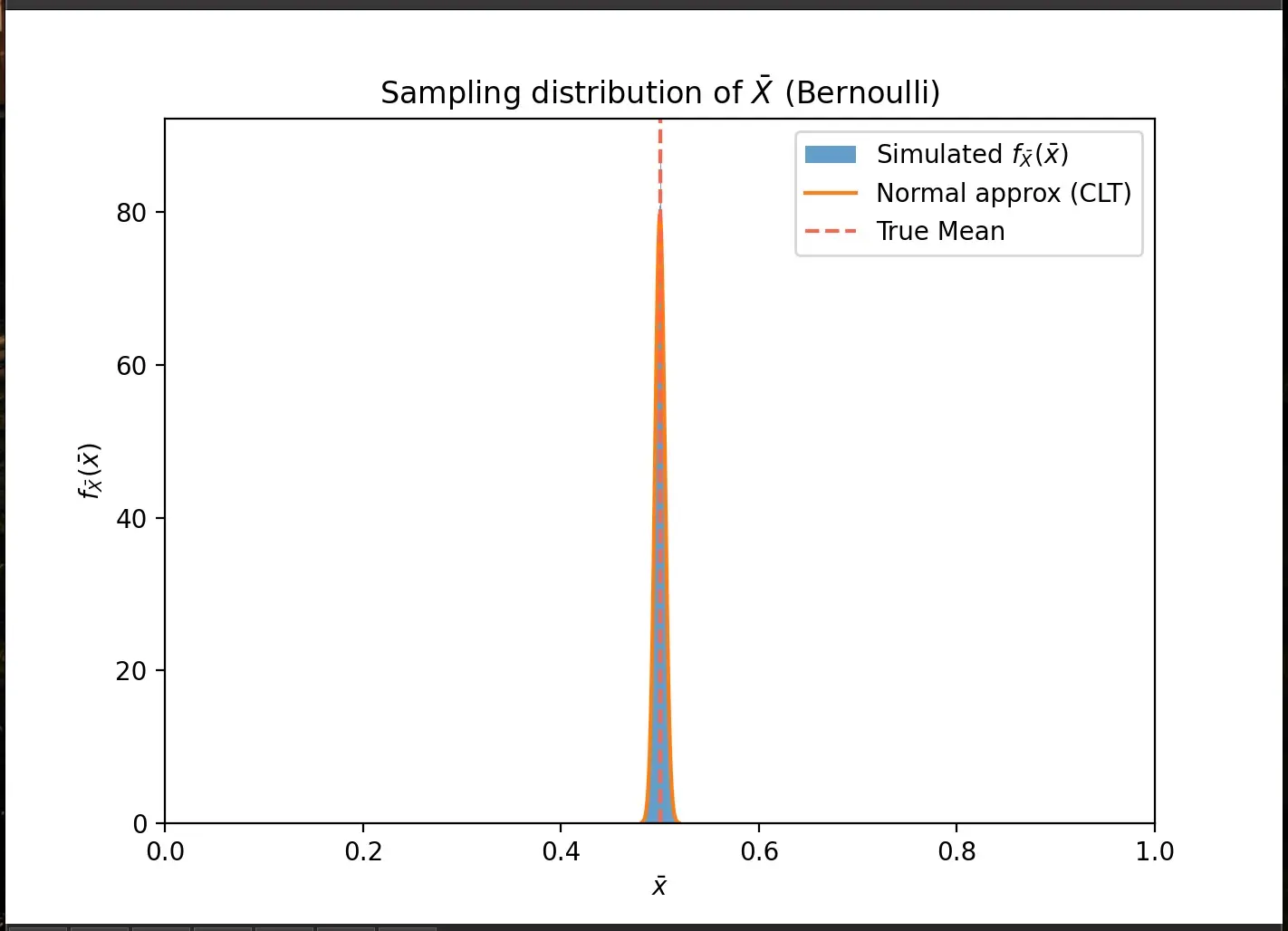
Hence, under the normal approximation, the distribution of Xˉ concentrates at p and converges to a degenerate distribution at p.
-
This implies that the sample proportion converges in probability to p:
n→∞limnX=p.
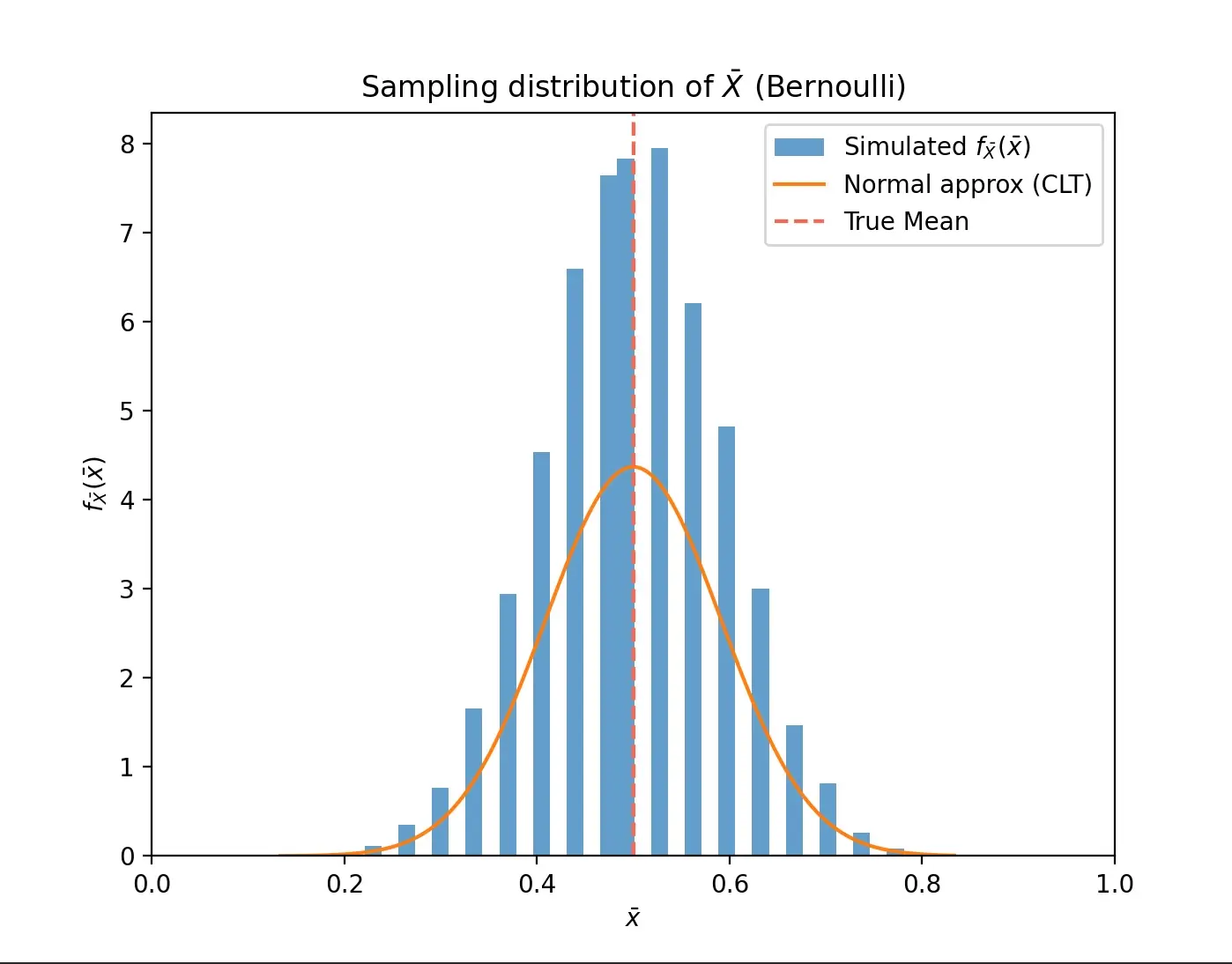
Diagram Comparison
n = 30
n = 10000